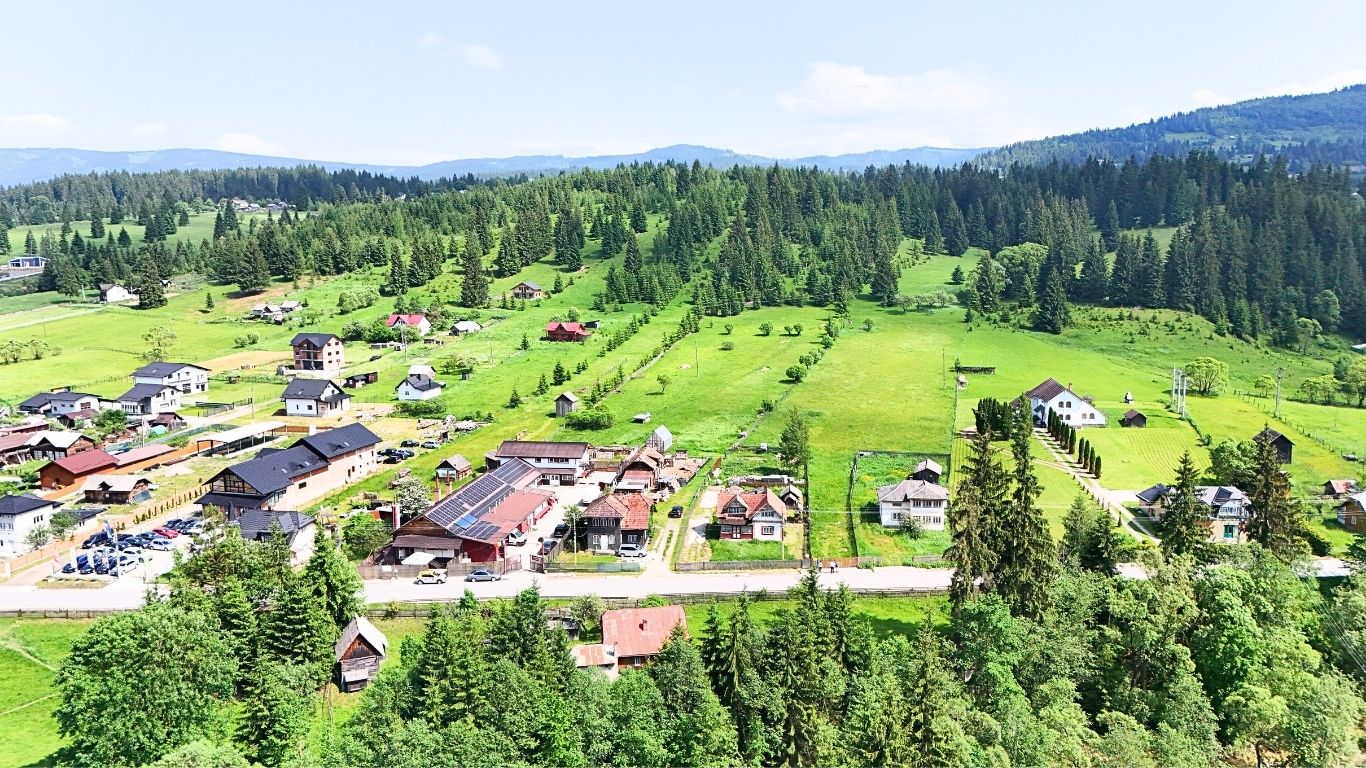
Investment overview: Romania can be an interesting property market for international buyers seeking lower entry prices than many Western European locations, access to an EU economy and a choice of residential, mountain, land and hospitality assets. But a good country-level story does not automatically make every property a good investment. Returns depend on the purchase price, location, legal status, condition, operating costs, financing and exit demand. This guide explains how to assess the opportunity without treating projected yield or capital growth as guaranteed.
Why international property buyers consider Romania
Romania combines several characteristics that attract international buyers: EU membership, a large domestic market, established university and commercial centres, mountain and spa destinations, and property types available at widely different budgets. The investment case is therefore broader than a simple comparison of average prices.
Recent European housing data provides useful context, but it should be interpreted carefully. Eurostat reported that EU house prices increased by 5.1% year-on-year in the first quarter of 2026. That figure describes the EU as a whole and does not predict the future value of an individual Romanian asset. Investors should use historical market data as context, not as a promise of appreciation. See the Eurostat house-price release for Q1 2026.
Location is decisive. Bucharest has the country’s deepest employment and rental market, while cities such as Iași, Cluj-Napoca, Timișoara and Brașov have their own combinations of universities, services, technology, tourism and regional business activity. Smaller markets may offer lower entry costs or distinctive lifestyle demand, but they can also have fewer comparable transactions and a narrower resale audience.
Romania’s mountain and spa regions represent another type of opportunity. Vatra Dornei and the wider Bucovina area appeal to buyers looking for a substantial residence, holiday home, small hospitality concept or long-term lifestyle asset. These properties should not be evaluated using the same assumptions as a city apartment. Access, winter maintenance, utilities, land status, energy performance, seasonality and local management all influence the result.
Which Romanian property investment strategy fits your objective?
Before comparing listings, define what the asset must achieve. A buyer seeking regular rental income will evaluate a property differently from someone seeking a family residence with long-term value, a hospitality business or land for future development.
City residential property
Apartments in large employment and university centres may offer a relatively understandable rental model. Relevant questions include the micro-location, transport, nearby employers or universities, building age, energy costs, service charges, tenant profile and supply of competing rentals. Headline rent is not the same as net income: vacancy, furnishing, repairs, insurance, administration and taxation must be included.
Commercial and mixed-use property
Commercial property can produce contracted income, but the lease matters as much as the building. Buyers should examine the tenant’s financial quality, remaining lease term, indexation, break clauses, maintenance obligations, guarantees and re-letting prospects. A high advertised yield can be compensation for a weak tenant, deferred repairs or limited demand after the current lease ends.
Hotels and hospitality assets
A hotel is an operating business as well as a building. Evaluation should cover historic revenue, occupancy, average daily rate, seasonality, staffing, food and beverage operations, licences, fire-safety compliance, equipment, deferred capital expenditure and the intended management model. A buyer acquiring only the real estate faces a different risk profile from one acquiring the operating company or business assets.
Mountain villas and holiday homes
A mountain residence can combine personal use with possible rental activity, but income should never be assumed from photographs or location alone. Verify legal access, snow clearance, water and sewage, heating, insulation, internet availability, local management, insurance and the rules applicable to short-stay accommodation. A beautiful large house may also require significant ongoing heating and maintenance.
Development land
Land can offer flexibility, but it carries high information risk. The words intravilan and extravilan do not by themselves confirm that a proposed project can be built. Buyers need current cadastral information, land-registry records, access rights, utility evidence and an urban-planning certificate explaining the applicable planning regime. Agricultural or forest land may involve additional restrictions and procedures.
Selected property opportunities currently listed in Romania
The following examples illustrate three different strategies. They are listings, not guaranteed investments, and all dimensions, facilities, legal documents, operating information and costs must be independently verified before purchase.
Operating hotel and restaurant opportunity in Iași
The current listing presents a hotel and restaurant complex in Iași at an asking price of €3,449,000, with 4,600 m² of built area, a 6,148 m² plot, accommodation, restaurant capacity, conference facilities, spa amenities and a swimming pool. For a hospitality investor, the next step is not simply to compare the price per square metre. The critical review concerns verified accounts, revenue by department, occupancy, payroll, supplier obligations, licences, technical condition, capex and the exact assets included in the proposed sale.
View the hotel and restaurant listing in Iași
Buyers exploring this segment can also review the dedicated hotels for sale in Romania page, which explains additional hospitality due-diligence points.
Large passive-house opportunity near Vatra Dornei
Listed at €490,000, this Vatra Dornei property is presented with approximately 500 m² of living space, seven bedrooms, three bathrooms and around 5,000 m² of land. Its energy-efficient construction and mountain setting may appeal to a buyer seeking a premium residence, retreat or accommodation concept. Any passive-house certification, heating-cost claim, system specification and energy-performance figure should be checked against original certificates, bills and a specialist technical inspection.
Explore the passive house in Vatra Dornei
For additional context, see the site’s overview of passive and energy-efficient homes in Bucovina.
Panoramic mountain villa with a substantial estate
The second premium Vatra Dornei listing has an asking price of €498,000 and is presented with approximately 370 m² of living space, seven bedrooms, three bathrooms and a 14,000 m² estate. The land area may create lifestyle or project possibilities, but no development assumption should be made without checking the cadastral plan, zoning, access, utilities and current planning documentation.
View the panoramic villa in Vatra Dornei
Compare current mountain properties on the dedicated Vatra Dornei villas for sale page.
Can foreigners buy property in Romania?
The answer depends on citizenship, the buyer’s legal status and whether the transaction includes land. Under Romania’s Law no. 312/2005, citizens and qualifying legal entities from EU or EEA member states may acquire land under the same conditions established for Romanian citizens and Romanian legal entities. Buyers from third countries are subject to the conditions established by international treaties on the basis of reciprocity.
Official wording matters because an apartment, a building and the land associated with a property may raise different questions. A Romanian company may be relevant in some structures, but forming a company should never be presented as an automatic shortcut. It creates legal, accounting, tax and governance obligations that require individual professional advice.
Read the current text of Romania’s Law no. 312/2005 on foreign ownership of land, and ask a Romanian notary and an independent lawyer to confirm how the rules apply to the exact buyer and property.
The notary plays an essential role in the transaction, but buyers may also appoint their own lawyer and technical specialists. Independent representation is particularly valuable when the asset includes a company, business operation, multiple buildings, agricultural land, unregistered alterations, private access or complex planning history.
How to calculate a realistic property return
Advertised rental yield is usually a starting point rather than the final answer. Investors should distinguish clearly between gross and net return.
Gross rental yield is annual rent divided by the total acquisition price, multiplied by 100. It does not account for operating costs.
Net operating yield uses annual rent minus realistic recurring operating expenses, divided by the total cash invested. The investment base should normally include the purchase price and directly attributable acquisition and initial works costs. Financing costs and taxes may then be modelled separately according to the investor’s structure.
Illustrative example only: if a property costs €200,000 and produces €14,400 in annual rent, the headline gross yield is 7.2%. If vacancy, maintenance, insurance, management and other recurring expenses total €4,000, annual net operating income becomes €10,400. Before acquisition costs and financing, that equals 5.2% of the purchase price. The example does not describe a current listing or predict an achievable result.
For a hotel, replace simple annual rent with a full operating model. Test revenue by room and department, cost of sales, payroll, utilities, maintenance, distribution commissions, insurance, taxes, management fees and a reserve for future refurbishment. Run at least a base case, a downside case and a severe downside case.
For a holiday property, model occupancy by month rather than applying one annual percentage. Include platform or agency costs, cleaning, linen, utilities, local management and periods reserved for personal use. For development land, there may be no operating income at all; return depends on planning, infrastructure, construction feasibility and exit value.
Property due diligence in Romania: a practical checklist
A disciplined process reduces the risk of discovering expensive issues after signing. The appropriate checks depend on the asset, but most buyers should consider the following:
- Identity and authority: confirm the seller’s identity and legal capacity to sell.
- Land registry: obtain a current Carte Funciară extract and review ownership, mortgages, liens, easements and other registered rights.
- Cadastre: compare cadastral documentation with the physical boundaries, buildings and measured areas.
- Building legality: verify permits, completion documentation and registration of later extensions or alterations.
- Planning: confirm the permitted use and applicable urban-planning rules, particularly for land, commercial and hospitality projects.
- Access: determine whether the access road is public or private and whether easements are properly documented.
- Utilities: verify actual connections, capacity, contracts and any reliance on wells, septic systems or private infrastructure.
- Technical inspection: use an appropriate specialist to examine structure, roof, moisture, electrical systems, heating, insulation and major equipment.
- Operating evidence: for income-producing property, reconcile leases, bank receipts, occupancy reports, licences, costs and tax information.
- Tax and acquisition costs: obtain a calculation tailored to the buyer, transaction and ownership structure rather than relying on a generic percentage.
- Translation: ensure that the buyer understands every document signed and uses an authorised interpreter where required.
- Exit liquidity: consider who is likely to buy the property later and how long a resale could realistically take.
A reservation payment, letter of intent or preliminary agreement can create obligations. Independent review should occur before money is transferred or binding documents are signed.
What are the main risks of investing in Romanian property?
Local variation: national averages can hide major differences between neighbourhoods, property types and individual buildings.
Documentation: discrepancies between the physical property, cadastral records and permitted construction can delay or prevent a transaction.
Renovation and energy costs: older buildings and large mountain properties may require more capital than an initial viewing suggests.
Vacancy and seasonality: university rentals, holiday homes and hotels have different demand cycles. Current occupancy should not be projected indefinitely.
Currency and financing: buyers earning, borrowing or reporting in another currency should model exchange-rate and interest-rate changes.
Management: a property located far from the owner requires reliable local administration, particularly for short stays or hospitality.
Resale: specialised or high-value regional assets may take longer to sell than a standard apartment in a large city.
Regulatory and tax changes: current rules can change. Tax treatment also depends on residence, ownership structure and the activity carried out. Obtain current advice before purchase and during ownership.
Who may find Romania suitable—and who may not?
Romania may be suitable for buyers who are prepared to research a specific location, compare evidence, maintain a contingency budget and use independent professionals. It may also suit buyers who value personal use or lifestyle alongside financial considerations, especially in distinctive mountain and regional markets.
It may be less suitable for someone requiring guaranteed income, immediate resale liquidity, fully passive ownership without local management or a transaction based only on an advertised yield. No property market removes operational, legal or market risk.
A useful decision rule is straightforward: do not buy because Romania appears inexpensive compared with another country. Buy only when the specific asset, documentation, total cost, realistic income scenario and exit plan work together.
Frequently asked questions
Is Romanian property cheap compared with Western Europe?
Some Romanian locations and property types have lower asking prices than major Western European markets, but country-level comparisons can be misleading. Compare similar locations, condition, usable area, legal status, income potential and resale demand. A lower purchase price does not automatically mean better value.
Can a foreigner buy a house with land in Romania?
EU/EEA buyers generally have broader land-ownership rights under Romanian law. Rules for buyers from third countries depend on international treaties and reciprocity. Because a house transaction can include both a building and land, obtain property-specific advice from a Romanian notary and independent lawyer.
What is a good rental yield in Romania?
There is no single reliable figure for the whole country. A meaningful return depends on the city, micro-location, property type, price, vacancy, condition, expenses, tax position and management model. Calculate gross and net returns from verifiable evidence and test a downside scenario.
Is a hotel in Romania a passive property investment?
Usually not. A hotel combines real estate with an operating business. Unless it is leased to a credible operator under a suitable agreement, ownership normally involves management, staffing, licensing, marketing, maintenance and capital expenditure.
Are Vatra Dornei properties suitable for holiday rentals?
Some may be suitable, but demand and operating performance must be assessed property by property. Confirm access, utilities, heating, management, permits, classification requirements, seasonality and realistic occupancy before relying on rental income.
Does East Europe Property provide legal or investment advice?
No. East Europe Property provides property discovery, English-language information and local introduction support. Buyers should instruct independent Romanian legal, notarial, tax, technical and financial professionals.
Explore selected Romanian properties with clearer local context
Tell us your preferred location, budget, property type and buying objective. We can help you identify relevant listings and prepare the next local introduction while keeping independent due diligence at the centre of the process.
Browse properties in Romania Request buyer guidance
Listing information and asking prices were reviewed on 13 September 2026 and may change. Availability, dimensions, features, legal status, energy claims, operating results and development potential must be independently verified. This article is general information, not legal, tax, financial, notarial or investment advice.